Jesus – Invitation or Declaration?

“Just as people are destined to die once, and after that to face judgment, so Christ was sacrificed once to take away the sins of many; and he will appear a second time, not to bear sin, but to bring salvation to those who are waiting for him” (Hebrews 9:27-28).

Jesus proclaims…
Jesus declares…
Jesus teaches…
Jesus announces…

Yup. That’s in the gospels. That’s in the Bible.

Jesus invites us to receive him as Lord…

Nope. Not once in the Bible.

R. C. Sproul wrote, “God doesn’t invite people to come to Jesus. He commands it with divine authority and convicts you of treason on a cosmic level if you refuse.”

Wowsers!

The language of invitation is so much more friendly, it’s nicer. But it’s misleading. Invitations can be perceived as I can take it or leave it.

But, that’s not the case with Jesus. Jesus ushers in the Kingdom of God and proclaims that the Kingdom of God is at hand. Jesus proclaims, declares, teaches, and announces the pathway to God’s Kingdom. Should we reject, what awaits those who have rejected Jesus is judgment.

R. C. Sproul is correct. When the time of judgment comes, it will have nothing to do with having done more good things vs. bad things. It will have nothing to do with how nice we were. It will have everything to do with what we did with the Kingdom Jesus proclaimed.

Jesus loves you. Jesus died for you. Jesus rose again from the dead for you. Receive Jesus as your Lord and Savior. Live as Kingdom people.
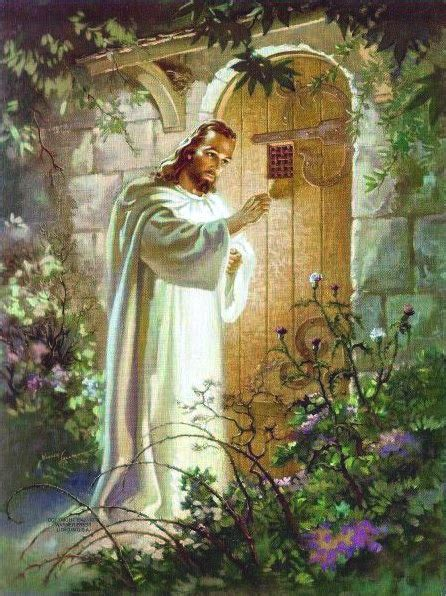
I Stand at the Door and Knock…Let Me In

“Here I am! I stand at the door and knock. If anyone hears my voice and opens the door, I will come in and eat with that person, and they with me” (Revelation 3:20).

The verse of the day is a well known verse amongst church going folk, and the painting that we think of is the one above. There are several things to note about the verse and the painting:

  1. Jesus is standing at the door and he wants to come in
  2. Jesus wants to come in so that he can fellowship with those inside
  3. Jesus is knocking
  4. There is no door knob. The only way this door can be opened is from the inside

The verse is often used to invite non-Christians to receive Jesus as Lord and Savior. And, it can be used that way because Jesus loves non-Christians too, but that’s not the context of this passage. The people inside that this passage is referring to are the Christians at Laodicea. Jesus is knocking on the door asking the people of the church of Laodicea to let him in.

Just because there is a cross or a steeple or it says such and such church does not necessarily mean that Jesus is present there. There are contexts in where the church gathers but Jesus is absent because the church isn’t gathered because of Jesus. The church has her own agendas other than the agenda of Jesus. When that happens, Jesus is on the outside knocking on the door.

The church exists because Jesus has given the church a mission. That mission is to make disciples and grow disciples who share the love of Jesus with all people. When the church is about anything other than this mission, Jesus is standing on the outside wanting to be let in.

The Little Church on the Prairie and Lakewoodgrace exists for one purpose, and one purpose only – to Make Disciples and Grow Disciples who Share the love of Jesus with all people.

Keep the main thing the main thing.

Forgiven

“Forgive, and you will be forgiven” (Luke 6:37).

Pastor John Ortberg tells the following story:

This year we had a daughter graduate from Azusa Pacific University. My wife spoke at the commencement, so we gathered with a group of fifty or so faculty, alumni, and administration before the ceremony. A few dozen people had graduated fifty years earlier, and they were there also to celebrate with their freshly minted co-alumns.

At one point, Jon Wallace, the university president, pulled three seniors into the center of the room and told us all they were going to be serving under-resourced people in impoverished areas for several years after graduation. The graduating seniors said a few words about where they were going and why, and we applauded. They thought that was why they were there. Then Jon turned his back to the rest of us, faced the three students, and told them the real reason they were in the room.

“Somebody you do not know has heard what you’re doing,” Jon said. “He wants you to be able to serve the people where you are going without any impediment. So he has given a gift. He has asked to remain anonymous, but here is what he has done for you.”

Jon turned to the first student and looked her in the eye. “You have been forgiven your school debt of $105,000.”

It took a few moments for the words to sink in. The student shook her head at first. The thought registered. She began to cry at the sheer unexpected generosity of a mountain of debt wiped out in a moment by someone she had never met.

Jon turned to the next student. “You have been forgiven your debt of $70,000.”

Jon turned to the third student. By this time she knew what was coming. But it was as if she could not believe it was happening until she heard the words. “You have been forgiven your debt of $130,000.”

All three students were trembling. Their lives had been changed in a twinkling by the extravagance of someone they had never met. All of us who watched were so moved, it was as if we had experienced the forgiveness ourselves. There was not a dry eye in the room.

An unpayable debt. An unseen giver. Unforgettable gift.

That’s grace.

That’s Jesus.

That’s forgiveness.

Friends, “You have been forgiven your debt. Jesus paid it all.”