“Live such good lives among the pagans that, though they accuse you of doing wrong, they may see your good deeds and glorify God on the day he visits us” (1 Peter 2:12).
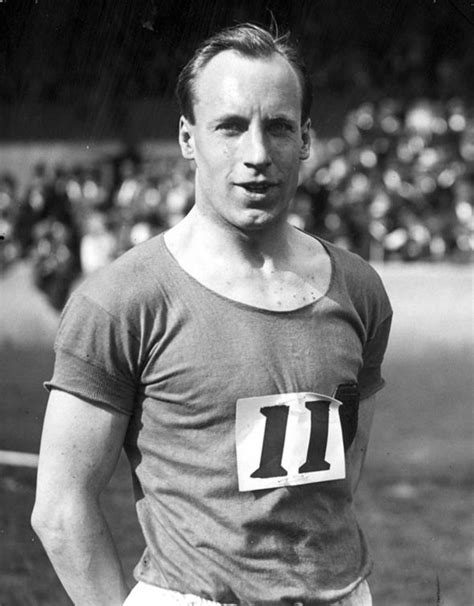
Eric Liddell was the greatest runner of his time. When the 1924 Paris Olympics were approaching he withdrew from the 100 meters (his best event) because the races would take place on a Sunday. Instead, he trained for the 400 meters where his best time was at best average by Olympic standards. To make a long story short, Liddell not only medaled but broke the Olympic and world records for the 400 at the Paris Games.
Liddell would later become a missionary to China. Liddell is quoted as saying, “We are all missionaries. Wherever we go we either bring people nearer to Jesus or we repel them from Christ.”
The lives we live either point people to Jesus and his grace, or is the reason why many reject Jesus.
Christian, people are watching to see if there’s any truth to this Christianity thing. Some are hoping against hope that this God of grace and love is for real. Be the reason why people believe in the grace and the love of Jesus.
We will close with what Martin Luther said. “God does not need your good works, but your neighbor does.”
Live such good lives that they may see your good deeds and glorify God.
“Above all else, guard your heart, for everything you do flows from it” (Proverbs 4:23).
The above translation is not helpful. When we read “guard your heart” we think God is telling us to be careful about our feelings or emotions. But, that’s not what the Jews meant by the heart. For us, the heart is the place of emotions and feelings. But for the Jews, the heart was the place of the will and thoughts. The heart, for the Jew, was a lot like our brains.
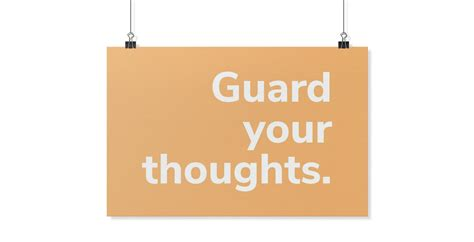
What God is asking us to do is to guard our thoughts, for from our thoughts everything flows from it.
I have been convicted about this particularly when it comes to how I speak to myself. I say things to myself that I would never say to another person:
You are so stupid!
That was so dumb…You’re an idiot!
Yikes! I would never say that to anyone. And, yet, I say things like that to myself all the time.
Guard your thoughts. This is not helpful.
So, how do you guard your thoughts?
Ask yourself two questions:
Does this harm me?
Does this help me?
Guard yourself from thoughts that harm, thoughts that push you further away from God.
Be kind to yourself. Guard your thoughts for it is from your thoughts and what you say to yourself that everything flows from it.
“Truly I tell you,” Jesus replied, “no one who has left home or brothers or sisters or mother or father or children or fields for me and the gospel will fail to receive a hundred times as much in this present age: homes, brothers, sisters, mothers, children, and fields – along with persecutions – and in the age to come eternal life” (Mark 10:29-30).
Did you see what Jesus did there? He snuck in persecutions. That wasn’t in the original list.
It is impossible to read the New Testament without seeing that persecution is par for the course for the Christian.
One of the Christianese phrases that irk me is “The safest place to be is in the center of the will of God.”
A couple of reasons why this phrase bothers me.
This wasn’t true for Jesus. Jesus was absolutely in the center of the will of God and it led him straight to the cross.
This wasn’t true for the disciples or the early church. They were in the center of the will of God and all of them were persecuted, imprisoned, and put to death for their faith in Jesus.
But, perhaps, the reason why this phrase irks me is because of the way our modern world understands the word “safe.” For us, safe means free from harm, risk, and danger. The carefree life.
Safe doesn’t always mean free from harm, risk and danger. Safe can also mean the best, most correct. Let me give you an example.
Corrie ten Boom’s sister, Betsie, was encouraging her with this hope while in Ravensbruck concentration camp. For Corrie and Betsie, the promise of safety in the center of God’s will was fleshed out in concentration camps during the Nazi holocaust of the Jews. And although Corrie lived to tell the story, Betsie died in the midst of it.
Clearly neither of them concluded that this expression conveyed a belief that God would keep them from suffering hardship and even death. Betsie’s statement was a declaration that to walk in the character of Christ is always the right choice, regardless of outcome or consequence.
The original call of Jesus was so simple, so clean, so clear: “Follow me.” He wants us to surrender our lives to him and follow him into the unknown. And if it means a life of suffering, hardship, and disappointment, it will be worth it because following Jesus is more powerful and more fulfilling than living with everything in the world minus him.
We understand clearly that we follow the God who chose the way of the Cross. If Jesus would not avoid the “place of the skull,” then we should not be surprised where he might lead us. If even he found Himself sweating blood at Gethsemane, then we should be certain we will stand at crisis moments where all we can do after asking for relief is declare, “Not my will, but Yours.”
Betsie ten Boom, as she lay dying in Ravensbruck concentration camp, turned to her sister Corrie and said, “We must tell them that there is no pit so deep that He is not deeper still. They will listen to us, Corrie, because we have been there.


 Praxis: Faith in Action