Psalms and Liturgy – the Language of Prayer

“In the same way, the Spirit helps us in our weakness. We do not know what we ought to pray for, but the Spirit himself intercedes for us through wordless groans” (Romans 8:26).

I know, that you know, praying is important. We all get it. But the thing is, praying is hard. Sometimes we don’t know what to pray. We don’t know how to pray. We don’t know what to say. Or we end up saying the same thing over and over.

There was a time when I was dealing with depression. I didn’t want to be around anyone. I didn’t even want to open my curtains. I wanted to be alone. I wanted to run away. I didn’t know where…just not here.

When I found myself in that dark place, I didn’t want to pray. Actually, it wasn’t so much I didn’t want to pray as much as I didn’t know what to say. I knew God was the key to getting out of that darkness. I knew I was wrong. I knew I had sinned. I knew I had gotten myself into that dark place.

This is where liturgy and the psalms are such an important part of our spiritual practices. Psalms are prayers. A third of the psalms are laments. When you don’t have words to pray, pray the psalms. Read the psalms and pray those words as if they were your words.

When I found myself in that dark place, it was psalms that provided the words for the prayers I needed. The second thing that helped me was liturgy. When I didn’t know what to say, I prayed the breath prayer, “Lord have mercy on me…a sinner.”

The way breath prayers work is to pray “Lord have mercy on me” as you breathe in, and pray “a sinner” as you breathe out. I prayed that for hours, for days, for weeks.

Then it happened. In time, the darkness didn’t seem so dark anymore. And the more I prayed, the more the darkness retreated.

God gives us the Holy Spirit to pray for us when we don’t even have the words to articulate what’s going on in us. When that happens, get in the psalms. Let the words of the psalms provide you with the language of prayer when you’ve run out of words.
Making Time and Space for God

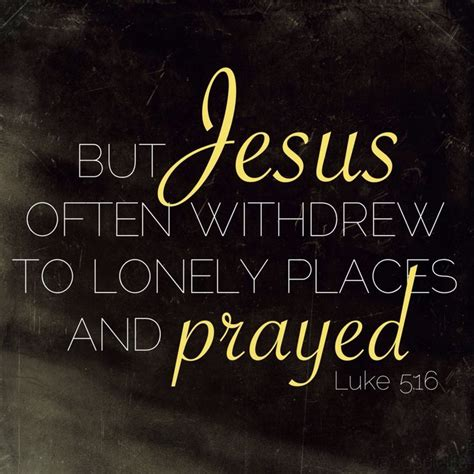
“But Jesus often withdrew to lonely places and prayed” (Luke 5:16).

Happy Independence Day!!! Have a safe, fun, blessed day. 

Now, onto the verse of the day. 

It was the habit of Jesus to make time to pray.

I find it interesting that the second person of the Holy Trinity, the Son of God sought out time to be alone with God when he was fully human here on planet earth. Jesus needed that time with God to be reminded of who he was, and who God is.

This reality begs the question, “If Jesus needed time alone with God to pray, what does that say about our need to pray?”

I want you to notice several truths about the way Jesus prayed.

  1. Jesus made time to pray – “Jesus often withdrew” to pray
    • Jesus had plenty to do. People needed healing. Disciples needed discipling. The crowds needed teaching. Demons needed casting out. There was amazing need all around him. Yet, Jesus made time to pray.
  2. Jesus made space to pray – “Jesus often withdrew to lonely places” to pray
    • What’s with “lonely” places? When Helen and I were courting, for three years I lived in Virginia while attending seminary while Helen stayed in Los Angeles. When we had the chance to get together, being with friends and family were fine, but that’s not the reason why we made time to be in the same space together. We needed lonely places, quiet places to be together.
    • We make space – space that will give us time alone with God – so that we can be together alone with God

So, how are you making time for God so you can pray? What is your lonely place?

If you don’t have a routine and a location, how about starting now. Think about a time and location where you can be alone with God. Then carve out that time and protect that space. And, most importantly, pray.

Pray Continually

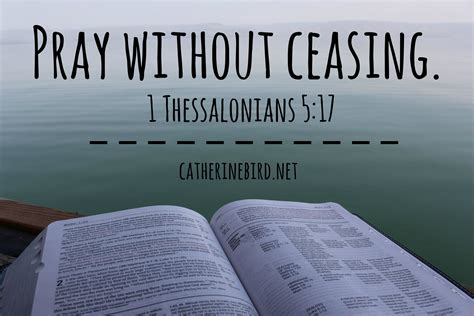
“Rejoice always, pray continually, give thanks in all circumstances; for this is God’s will for you in Christ Jesus” (1 Thessalonians 5:16-18).

I am a simple man. I like clarity. I appreciate it when the Bible doesn’t beat around the bush and just comes out straight and tells me what God’s will is.

That’s why I love our text. It just simply tells us “this is God’s will for you.”

So what is God’s will for us?
1. Rejoice always
2. Pray continually
3. Give thanks in all circumstances

Pay attention to these words: “always,” “continually,” and “all circumstances.” That’s pretty comprehensive.

This is God’s will for you and me. Since this is God’s will we ought to do what God is telling us to do.

The key to rejoicing always and giving thanks in all circumstances is in praying continually.

We are to pray without ceasing. There are different ways to pray and different types of prayers. One of the ways that God calls us to pray is to constantly be in conversation with God. Just like very few of us like to go anywhere without our smartphones these days, God is saying, remember that I am with you always.

Keep talking to God throughout the day as if God we’re with you…because he is. When we become aware of God’s presence with us at all times, we will find ourselves rejoicing always and giving thanks in all circumstances because God is with us. There is never a time or place or circumstance in which God is absent.

This is God’s will for you. Rejoice always and give thanks in all circumstances by praying continually.