God’s Teaching on Wealth and Money

“Now he who supplies seed to the sower and bread for food will also supply and increase your store of seed and will enlarge the harvest of your righteousness. You will be enriched in every way so that you can be generous on every occasion, and through us your generosity will result in thanksgiving to the Lord” (2 Corinthians 9:10-11).

John Piper writes, “God gives his people money so that we can use money in a way to show that money is not our God.”

The text today teaches us several things about wealth.

First, God “will increase and enlarge the store of seed.” God will give us more than enough. Why does God give us more than enough to take care of ourselves and our families?

Second, the text tells us that God gives us more than enough so that we “can be generous on every occasion”. God gives us more than enough so that God’s people can be engaged in God impacting the world.

Why doesn’t God just distribute his wealth to others? Because when the church is leading the way in the ministry of compassion and generosity, it “results in thanksgiving to the Lord.”

God is not against God’s people having things. In fact, God is not against God’s people having much. What God is against is when things have us. The plan for God’s people is the tithe. Look, if you need to upgrade your television, go for it. If you need to upgrade your car, go for it. But, make sure you have given God his tithe first. After you have dedicated your tithe to God, go ahead and upgrade your tv or car or laptop or phone or whatever. But the problem arises when you upgrade your things at the expense of God’s tithe.

God is not against you having stuff. God is against stuff having you. Got it?
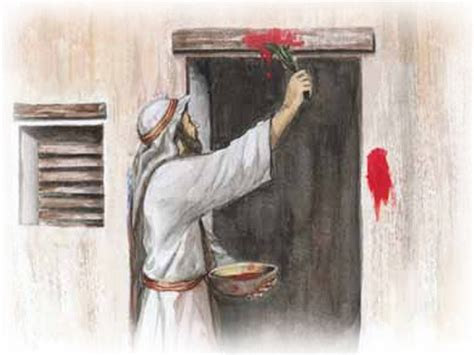
Are You Covered by the Blood of the Lamb?

“When the LORD goes through the land to strike down the Egyptians, he will see the blood on the top and sides of the doorframe and will pass over that doorway, and he will not permit the destroyer to enter your houses and strike you down” (Exodus 12:23).

Today’s verse comes in the account of the Passover in Egypt. This would be the 10th and the final plague where the destroyer would take the life of every first born son in Egypt. The Israelites were given clear directions about sacrificing the sacrificial lamb. The heads of the households were given specific instructions about placing the blood of the lamb on the door frame of their houses.

On that Passover evening, the destroyer went through the land of Egypt and killed every single first born male in all of Egypt. The only houses that were spared were the houses with the blood of the lamb on the door frames.

The story of the Passover is the story of salvation. The Lord did not check to see if the people inside the houses were worthy. The only thing that the Lord checked for was the blood of the Lamb.

The reality is that no one is worthy to be saved. We are all guilty sinners. The only thing we can do is to accept the plan of salvation that God offers his people – the sacrificial blood of the Lamb.

When we stand in judgment the only thing that God will be checking for is the presence of the blood of the Lamb over our lives.

Friends, are you covered by the blood of the Lamb?

Walk with the Wise

“Walk with the wise and become wise, for a companion of fools suffers harm” (Proverbs 13:20).

Note: today’s entry is longer than usual. But, you will want to read the whole entry.

Scriptures have always been clear about keeping good company. Being around wise people absolutely matters. Now, there is good science to back it up. In a book called “Quiet” written by Susan Cain, she cites a brain study that shows why the Apostle Paul wrote, “Do not be misled: Bad company corrupts good character” (1 Corinthians 15:33).

Here is the study:

In 2005 an Emory University neuroscientist named Gregory Berns decided to conduct an updated version of Asch’s experiments. Berns and his team recruited thirty-two volunteers, men and women between the ages of nineteen and forty-one. The volunteers played a game in which each group member was shown two different three-dimensional objects on a computer screen and asked to decide whether the first object could be rotated to match the second. The experimenters used and fMRI scanner to take snapshots of the volunteers’ brains as they conformed to or broke with group opinion.

The results were both disturbing and illuminating. First, they corroborated Asch’s findings. When the volunteers played the game on their own, they gave the wrong answer only 13.8 percent of the time. But when they played with a group whose members gave unanimously wrong answers, they agreed with the group 41 percent of the time.

But Bern’s study also shed light on exactly why we’re such conformists. When the volunteers played alone, the brain scans showed activity in a network of brain regions including the occipital cortex and parietal cortex, which are associated with visual and spatial perception, and in the frontal cortex, which is associated conscious decision-making. But when they went along with their group’s wrong answer, their brain activity revealed something very different.

Remember, what Asch wanted to know was whether people conformed despite knowing that the group was wrong, or whether their perceptions had been altered by the group. If the former was true, Berns and his team reasoned then they should see more brain activity in the decision-making prefrontal cortex. That is, the brain scans would pick up the volunteers deciding consciously to abandon their own beliefs to fit in with the group. But if the brain scans showed heightened activity in regions associated with visual and spatial perception, this would suggest that the group had somehow managed to change the individual’s perceptions.

That was exactly what happened – the conformists showed less brain activity in the frontal, decision-making regions and more in the areas of the brain associated with perception. Peer pressure, in other words, is not only unpleasant, but can actually change your view of a problem.

What the Bible has always taught us, and what science now backs up is that when we surround ourselves with people who normalize sin long enough, wrong company makes what is wrong seem right. And that’s a big problem.

“Walk with the wise and become wise.”