The following is an excerpt from Eric Metaxas’ book, “Everything You Always Wanted to Know About God (But Were Afraid to Ask).
It happened on Christmas Eve, 48 years ago. Three men took turns reading from the first 10 verses of the Book of Genesis. They were nearly 250,000 miles away from Bethlehem, but since it was the night before Christmas, and there was no chimney from which to hang their stockings, the three astronauts inside the Apollo 8 capsule orbiting the moon thought it would be appropriate. So as Jim Lovell, Frank Borman and Bill Anders looked at the faraway Earth through the small window of the spacecraft, they read the verses: “In the beginning, God made the heavens and the Earth.”
Their distant-sounding voices from far beyond our atmosphere were broadcast live to the whole planet that night over radio and television. It was one of those moments that brought the world together, that helped us to see our common humanity as children of God whom he loves equally, and whom he placed on the beautiful planet that he made.
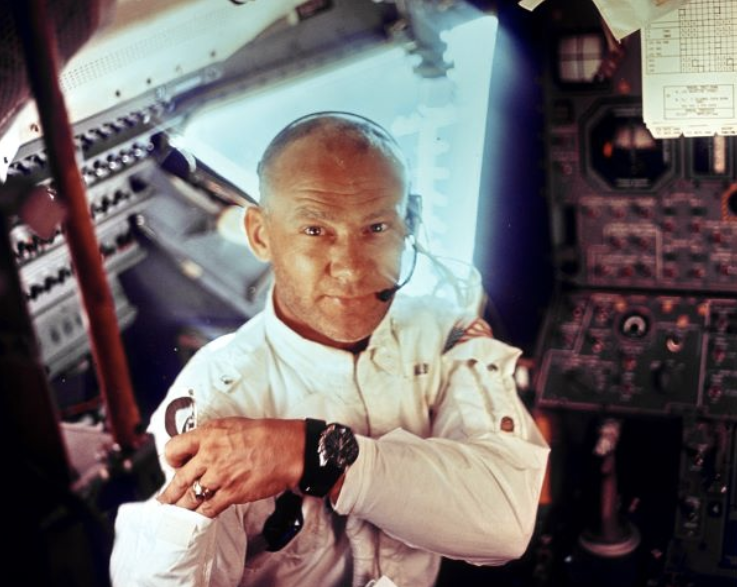
Seven months after this extraordinary event, in July 1969, another NASA spacecraft, Apollo 11, carried two astronauts to the surface of the moon itself. One of them, Commander Edwin “Buzz” Aldrin, thought he might do something similar to mark what was certainly an epochal moment in the history of our race. But what could one do to mark the first time human beings landed on another heavenly body? He asked Dean Woodruff, the pastor of his church in Webster, Texas, who had an idea.
What if he were to take communion? What is more basic to humanity than bread and wine? He could do it as his own way of thanking God—for the Earth and for everyone on it, and for our amazing ability to do things like build spacecraft that could fly to the moon. So the pastor gave him a small amount of consecrated bread and wine and a tiny chalice, and Mr. Aldrin took them with him to the moon. After the Eagle had landed and he and Neil Armstrong sat in the Lunar Module, Mr. Aldrin said this over the radio:
“This is the LM pilot. I’d like to take this opportunity to ask every person listening in, whoever and wherever they may be, to pause for a moment and contemplate the events of the past few hours and to give thanks in his or her own way.”
He then ended radio communication and there, on the silent surface of the moon, read a Bible verse, and took communion. For reasons he explains in his own account, none of this was made public until Mr. Aldrin wrote about it in Guideposts magazine the following year:
“In the radio blackout, I opened the little plastic packages which contained the bread and the wine. I poured the wine into the chalice our church had given me. In the one-sixth gravity of the moon the wine curled slowly and gracefully up the side of the cup.”
Then Mr. Aldrin read Jesus’ words from the Gospel of John: “I am the vine, you are the branches. Whosoever abides in me will bring forth much fruit. Apart from me you can do nothing.” He explained that he had wanted to read this over the radio back to Earth, but at the last minute NASA asked him not to because the agency was in a legal battle with the outspoken atheist Madalyn Murray O’Hair. As it happened, she was suing over the Apollo 8 crew reading from Genesis on Christmas Eve. And that of course is why so few people have heard of this amazing story.
I sometimes wonder what’s more amazing, this story—or the fact that so few people know about it. When I first heard it I almost couldn’t believe it was true, but about 10 years ago I had the honor and privilege of meeting Buzz Aldrin in person and asking him about it.
Mr. Aldrin said that he agreed not to read the words over the radio, but only “reluctantly.” I find his own words of the event very moving: “I ate the tiny Host and swallowed the wine. I gave thanks for the intelligence and spirit that had brought two young pilots to the Sea of Tranquility. It was interesting for me to think: the very first liquid ever poured on the moon, and the very first food eaten there, were the communion elements.”
And of course right now, as Christians around the world are celebrating the birth of Jesus, it’s fascinating to think that some of the first words spoken on the moon were his words, the powerless newborn in the dirty manger who came to Earth from heaven, and who made the Earth and the moon and all of us, in His own image. And who, in the immortal words of Dante, is himself the “Love that moves the Sun and other stars.”
Merry Christmas!!!